ACTI-TECH LTD

ACTI-TECH LTD
QUALITY PRODUCTS, CUSTOMIZED SOLUTIONS

Tuesday, October 20, 2015

Olufemi Olu-Kayode, former minister of aviation is expecting his first child with his beautiful girlfriend, Precious Chikwendu

Olufemi Olu-Kayode, former minister of aviation is expecting his first child with his beautiful girlfriend, Precious Chikwendu.
The heavily pregnant beauty queen and her mum had moved into the former minister’s Abuja home with a house maid.
Image result for femi fani kayode and girlfriend

The former minister who served as the spokesperson for the Goodluck Jonathan’s presidential campaign, and Precious are already living together as a couple.
Precious was the former Miss Valentine and Miss United Nations World 2014. She has been spoilt with gifts from the former minister, as bought a 2014 Range Rover for Precious earlier this year.
Precious Chikwendu who is also an actress and model is popularly known as Snow White.

Saturday, October 17, 2015

Russia Began Fielding Drones In Syria

Image result wey dey for Russia Began Fielding Drones In SyriaRussia's drone program, for years dormant and lagging behind the West, has resurfaced in a big way recently, with widespread use in Syria punctuated Friday by the downing inside Turkey of an unmanned vehicle that could belong to Moscow.
Russia began fielding drones in Syria in September as part of the military buildup that preceded airstrikes on behalf of its ally, the government of Syrian President Bashar al-Assad. Russian drones are also reportedly in use in Ukraine.
All told, Russian military and security forces have an inventory of about 800 drones, all believed unarmed and primarily used for intelligence and reconnaissance purposes, an analyst with HIS Jane's told CNN Friday.
Image result wey dey for Russia Began Fielding Drones In SyriaIt is not clear that the drone downed Friday by a Turkish warplane inside of Turkey -- which borders Syria -- is Russian. Moscow has denied the reports, although two U.S. defense officials say they believe the drone is Russian.
But it is clear that after years with little in the way of drone technology, Moscow has ramped up its emphasis on unmanned aerial vehicles in recent years, said Douglas Barrie, senior fellow for Military Aerospace at the International Institute for Strategic Studies.
Image result wey dey for image of Russia drone"In the aftermath of the collapse of the Soviet Union UAV R&D was neglected, and it is only in the past decade or so that Russia has re-focused attention on this area of military capability," he said.
In the last five years or so, Russia has relied significantly on models from Israeli defense contractors, some of which it has licensed to produce in Russia, said Derrick Maple, principle analyst for unmanned Systems at IHS Jane's.
Image result wey dey for image of Russia droneBut Russia has pledged to spend nearly $10 billion over the next decade to further develop its drone fleet, including muscular armed drones similar to some fielded by the United States, Maple said.

For instance, Russia has been developing an armed drone called Skat since at least 2005, according to IHS Jane's. The drone could be capable of carrying multiple anti-ship or radar missiles, guided bombs or conventional bombs.
Image result wey dey for image of Russia droneImage result wey dey for image of Russia drone

Drug Lord 'El Chapo' Escape Arrest

Fugitive drug kingpin Joaquin "El Chapo" Guzman suffered injuries while trying to escape as authorities closed in on him, Mexican officials said.
Guzman broke out of prison through an underground tunnel in July, and has been on the run since then.
In a statement Friday, officials said intelligence pointed them to focus on northeast Mexico.
Mexican officials said they launched an operation in the area, prompting the kingpin to make a hurried escape that left him with injuries on his face and one leg.
Authorities did not provide specifics on the date and exact location of the operation, or how he got injured.
Image result wey dey for Drug Lord 'El Chapo' Escape Arrest"It is important to note that these injuries were not the result of a direct confrontation," the statement said.
Mexico's most notorious drug lord stepped into a shower in July. He slipped through a hole in the shower stall and into a tunnel that led out of the maximum-security Altiplano Federal Prison, authorities said then.
The opening connected to a vertical passageway that was outfitted with a ladder and led to another tunnel that had tracks for a modified motorcycle.
It's unclear how or where Guzman went, but authorities have indicated that at some point during his escape, a pilot flew him farther from the prison.
"El Chapo," whose nickname means "short" in Spanish, seemed to have vanished into thin air.
Image result wey dey for Drug Lord 'El Chapo' Escape Arrest
While the notorious drug lord got a taste of freedom, those suspected of helping him escape were in custody.
A pilot accused of playing a role in his escape was arrested this month, the nation's attorney general said.
An additional 34 people have been arrested in connection with the July 11 escape.
Authorities have not said whether any of the suspects provided them with information to help track Guzman.
Mexico came under fire following the prison break for its inability to handle high-profile criminals, with critics pointing to corruption and the power wielded by drug cartels in the country.
Guzman's incident was not his first escape from prison.
Image result wey dey for Drug Lord 'El Chapo' Escape ArrestHe broke out of a maximum-security prison in 2001 while reportedly hiding in a laundry cart. Authorities arrested him in February last year -- after 13 years on the lam.
Then he escaped again in July this year.
The U.S. announced a reward of up to $5 million for information leading to his arrest. Mexico has offered $3.8 million.

Image result wey dey for Drug Lord 'El Chapo' Escape ArrestGuzman is charged with drug trafficking and related crimes in several U.S. federal courts, including Arizona, California, Texas, Illinois, New York and Florida.
Image result wey dey for Drug Lord 'El Chapo' Escape Arrest

Thursday, October 15, 2015

Israeli-Palestinian Violence Again

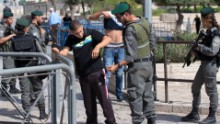
492615398, 49256562, 492565676, 492565620, 49263847, 492638478Over the past few weeks, violence in the decades long Israeli-Palestinian conflict has flared up.
Bloodshed is not unusual in this part of the Middle East but this particular wave of aggression -- stabbings as well as a shooting and driving into crowds -- is very different from rocket attacks or the orchestrated suicide bombings of the past.
The latest upsurge in violence in Jerusalem started with two Israelis being stabbed to death by a Palestinian in the Old City -- which was followed by a series of stabbings and other attacks.
A particular point of contention is the Temple Mount, known to Muslims as the Haram Al-Sharif, in the Old City.
In an unwritten arrangement in place since Israel took control of all of Jerusalem in 1967, Jews are not allowed to pray on the Temple Mount, where the Al-Aqsa Mosque and Dome of the Rock are situated.
bus station attack witness Jerusalem natpkg_00000000.jpgIncreasingly in recent years, hardline Jewish activists have demanded greater access to the Temple Mount and right-wing politicians have called for rights of Jews to pray there.
This has sparked widespread concerns among Palestinians that the status quo is being violated, and will end in the division of the Temple Mount.
Over the past few years, tensions have coincided with the Jewish High Holy Days in the autumn. This year, the holiday coincided with the Muslim's Eid-al-Adha holiday and tensions rose even higher.
In fact, the security situation in Jerusalem and the West Bank has been more and more tense since 2014 whenthree Israeli teenage settlers were kidnapped and murdered in the West Bank by militants from Hamas.
A few weeks later, Jewish extremists kidnapped and murdered a 17-year-old Palestinian from East Jerusalem. This further inflamed tensions and set off clashes in historically Arab East Jerusalem. A spate of attacks on Israeli civilians by East Jerusalem Palestinians wracked the city later in the autumn.
On July 31, in the West Bank, Israeli settlers burned a Palestinian house in a so-called "price-tag attack," killing an 18-month-old toddler and his parents. On October 1, an Israeli couple were shot dead in front of their four children near the Palestinian city of Nablus. Israeli police have arrested a Hamas cell they believe were behind the attack.
All this comes against a backdrop of what many Palestinians see as unending, humiliating Israeli occupation in place since the 1967 war when Israel conquered all of Jerusalem, Gaza, the West Bank and the Syrian Golan Heights.
Even Israeli intelligence officials are not blaming any of these attacks on any of the Palestinian militant groups or factions like Islamic Jihad or Al-Aqsa Martyrs Brigades or Hamas. Hamas has praised the attackers, but not claimed responsibility.
It seems that many of the attackers are motivated by what they see on Facebook and Twitter where photos and video of attacks are posted.
The suicide bombings that were hallmark of the Second Intifada required an infrastructure -- sourcing bombers, making and providing them with explosives and getting them into place to carry out the attacks. Israeli forces were able to break up much of this infrastructure by the end of that uprising.
Israel has invested a huge amount of money in developing an intelligence network -- including collaborators and informers -- in East Jerusalem and the West Bank, building a separation barrier (dubbed the "Apartheid Wall" by the Palestinians) around the West Bank to stop potential suicide bombers, and developing the Iron Dome missile defense system to intercept rockets firing out Gaza.
But, it's easy to buy a knife in Jerusalem. Knifings are the ultimate low-tech response to Israel's high-tech, high-cost security. They are a simple way to accomplish the same thing the suicide bombers did: scare the hell out of ordinary Israelis.
Ordinary Israelis are in a state of alarm. They are taking measures for protection: there are dramatically fewer people on the streets. Here, Israelis are reconsidering the routes they take to work -- driving rather than taking the bus or light rail.
There are more Israelis walking around with handguns and more people applying for weapon licenses. Jerusalem's Mayor Nir Barkat called on licensed gun owners to carry them. Palestinians are also scared; many more of them have died in reprisal attacks and shootings by security forces.
But there is bitterness and hatred, the likes of which I've never seen.
During the Second Intifada, which ran from 2000-2005, there was a lot of fear and mutual distrust but there was still a memory of when people did coexist going back to the early 1990s.
For the younger generation of Palestinians and Israelis, that's absolutely disappeared. After the Second Intifada and three wars in Gaza all they associate the other side with is violence.
In short, a lot of words and not much action.
Politically, Israeli Prime Minister Benjamin Netanyahu is under a lot of pressure to respond more aggressively.
One politician told him to "stop stuttering and start acting." An opinion poll published over the weekend found that 73% of Israelis are dissatisfied with the government's handling of the latest wave of violence. They want a harsher response to the attacks.
On the Palestinian side, leader Mahmoud Abbas, now 80 years old, doesn't have a lot of public support. He's seen as old, ineffective and soft on Israel. He has called for de-escalation, but other Palestinian leaders don't seem willing to follow his line.
The peace process went into intensive care during the Second Intifada and successive U.S. presidents have time and time again made attempts to revive it.
But under Ariel Sharon, who was prime minister from 2001 to early 2006, and Benjamin Netanyahu from 2009 until now, the Israeli government has been at best lukewarm about the peace process.
The last attempt to re-launch the peace process by U.S. Secretary of State John Kerry in the summer of 2013 went nowhere.
A major stumbling block is Israel's continued building of settlements in the West Bank. Estimates by Israeli human rights group B'Tselem say there are almost 550,000 settlers living in exclusively Jewish communities in the West Bank. The settlements are considered illegal under international law, something Israel disputes.
Kerry has said he will travel to the Middle East to help calm the situation, although given the bitterness between U.S. President Barack Obama and Netanyahu over his opposition to the Iran nuclear deal it's questionable as to how diplomatically involved the U.S. will want to get.
It's unlikely. It's an outburst that will probably subside.
The Second Intifada took a huge toll on Palestinians' economy and way of life. Many Palestinian youth are too young to remember the darkest days of the uprising -- but their parents remember it, and don't want to go through it again, even if they resent Israel's 48-year-old occupation.

They don't have the energy to go through years of violence and closures and arrests and deaths and funerals. My worry is that these outbursts will become more and more frequent. They will die down quickly but the mutual hatred will only deepen.