
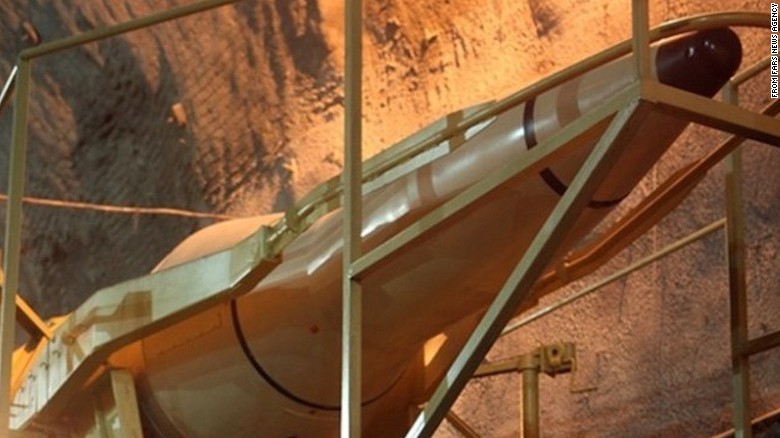
 At first glance it looks like
the set of a James Bond movie -- a seemingly impregnable mountain base packed
full of uniformed men and sinister-looking missiles on their launch vehicles
parked along a long tunnel buried deep underground.
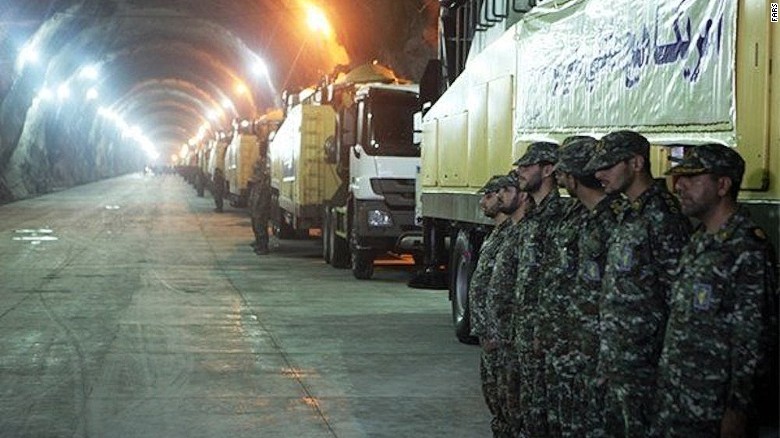
At first glance it looks like
the set of a James Bond movie -- a seemingly impregnable mountain base packed
full of uniformed men and sinister-looking missiles on their launch vehicles
parked along a long tunnel buried deep underground.
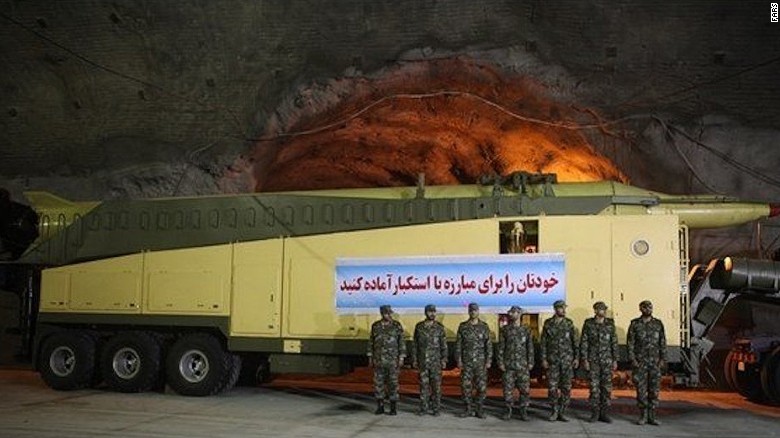
But
this is in fact a real-life missile facility in Iran, according to the
country's semi-official FARS news agency.
In
a rare moment of openness, Iran on Wednesday broadcast pictures from The
Islamic Revolution Guards Corps (IRGC) Aerospace Force of a tunnel reportedly
dug some 1,640 feet (500 meters) under a mountain.
The
release of this footage comes just a few days after state media reported that
Iran had test-fired new generation long-range ballistic missiles.
Based on information
the administration has so far, the test appears to be in violation of U.N.
Security Council Resolution 1929, which stipulates that Iran cannot engage in
any activities related to ballistic missiles.
 The U.S. official
emphasized, however, that the test is not in violation of the nuclear agreement
reached in July between Iran, the United States and five other world powers
because that accord is focused on restricting Iran's path to a nuclear weapon.
The U.S. official
emphasized, however, that the test is not in violation of the nuclear agreement
reached in July between Iran, the United States and five other world powers
because that accord is focused on restricting Iran's path to a nuclear weapon.
A newer U.N. Security
Council resolution, number 2231, implementing the deal and banning Iran from
engaging in activities related to ballistic missiles designed to carry nuclear
warheads is not yet in effect.
Iran is completely overhauling
its missile technology, replacing the current stockpile with newer weapons, a
senior general told state media.
"As
of next year, a new and advanced generation of long-range liquid and solid fuel
missiles will replace the current products," said Brigadier General Amir
Ali Hajizadeh.
"The
missiles in various ranges are mounted on the launchers in all bases and (are)
ready to be launched."
The
underground facility shown on television was only one of "numerous missile
bases" scattered across the country, according to Hajizadeh.
Earlier this month in a speech
at a university in Tehran, Hajizadeh said that all U.S. military bases in the
Middle East were within range of Iranian missiles.
The
revealing of the underground bases comes in the wake of a major deal reached by Iran and the
so-called P5+1 group of nations --
the U.S., U.K., Russia, China, France and Germany -- over its nuclear program.
Under
the deal, international sanctions on Iran will be lifted in return for
restrictions on its nuclear program aimed at preventing it from being able to
develop an atomic bomb.
Iran
is a major regional military power and Revolutionary Guards forces have been
active in Syria, working to prop up the regime of close Tehran ally Bashar
al-Assad with military aid and advisers.


